
Italy Work Permit Visa Moving to Italy to build a career is a dream for thousands of professionals around the world. From the world-famous fashion industry and luxury design sector to booming agriculture, hospitality, healthcare, and technology fields—Italy continues to open its doors to skilled foreign workers.
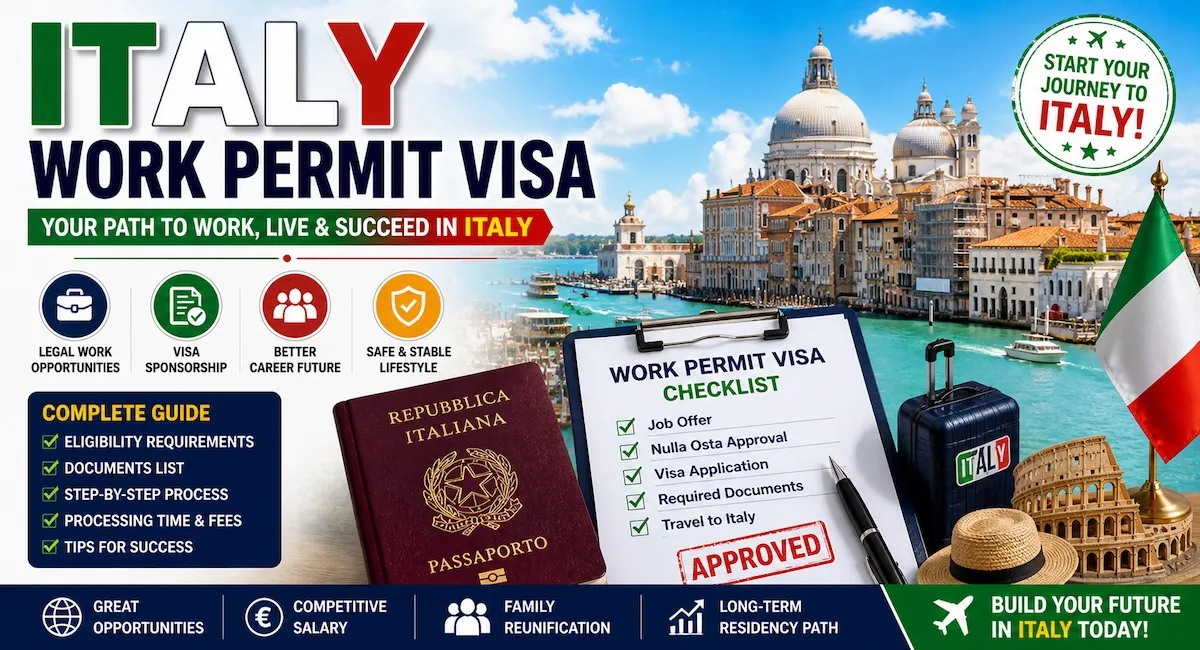
The Italy Work Permit Visa (often known as Decreto Flussi Work Visa) is one of the most sought-after European visas for job seekers because it can lead to long-term residence and a stable future in the European Union.
In this in-depth guide, we will explore everything you need to know about the Italy work permit system, eligibility criteria, step-by-step application process, job demand, documents, processing times, and more—explained in a simple and engaging way.
Why Italy Work Permit Visa is Highly Popular Among Foreign Workers
Italy offers a perfect combination of lifestyle, job opportunities, and long-term immigration benefits.
Here’s why thousands of applicants aim for Italy every year:
- High job demand in construction, hospitality, caregiving, agriculture, engineering, and IT
- Beautiful lifestyle with modern cities and rich cultural heritage
- Work-life balance compared to many other countries
- Family-friendly immigration policies
- Possibility of permanent residency after staying legally for a few years
- Pathway to EU long-term residence permit
A real example:
Rahman from Bangladesh secured a seasonal work permit through the Decreto Flussi program. After two years, his employer helped him convert it into a non-seasonal permit, allowing him to stay longer and later bring his family.
Stories like this show how the Italian work permit can open life-changing paths for workers worldwide.
Understanding the Italy Work Visa System (Decreto Flussi Overview)
Italy controls work permits through an annual immigration quota system called Decreto Flussi.
This program defines:
- How many foreign workers can enter
- Which job categories are allowed
- What type of work permit is issued
The program includes two major categories:
1. Seasonal Work Permit (Lavoro Stagionale)
Valid for 6–9 months for sectors like:
- Agriculture
- Tourism
- Hospitality
- Vineyards
Seasonal permits can often be renewed and even converted into non-seasonal permits.
2. Non-Seasonal Work Permit (Lavoro Subordinato)
Issued for long-term, permanent, or contract-based jobs, including:
- Construction
- Manufacturing
- Caregiving
- Hospitality
- Engineering
- Health & medical services
- Transport & logistics
- IT and digital services
This category can lead to permanent residency if the applicant maintains continuous employment.
Eligibility Criteria for Italy Work Permit Visa
To apply for the Italy work permit visa, you must meet the following conditions:
✔ You Must Have a Job Offer First
The Italian employer must be legally registered and willing to sponsor your work permit.
✔ Employer Must Apply for Nulla Osta
This is an official work authorization certificate issued by the Italian immigration authorities.
✔ You Must Meet Job Requirements
Some roles require:
- Technical skills
- Education certificates
- Training documents
- Language skills (mainly for healthcare or caregiving jobs)
✔ Clean Criminal Record
A police clearance certificate is often required.
✔ Valid Passport
Must not expire within the next 12–24 months.
If you meet these conditions, you can proceed with the work visa application.
Step-by-Step Process to Apply for the Italy Work Permit Visa
Applying for the Italy Work Permit Visa involves both employer and employee responsibilities.
Here is a clear breakdown:
Step 1: Find a Job with an Italy-Based Employer
Your employer must be willing to hire a non-EU worker and apply on your behalf.
Popular methods to find jobs include:
- Official Italian job portals
- EU job mobility platform
- Recruitment agencies
- Direct company applications
In-demand job categories:
- Construction workers
- Agriculture & farm workers
- Hotel & restaurant staff
- Caregivers
- Cleaners
- Manufacturing workers
- Truck drivers
- Welders & technicians
- IT professionals
Step 2: Employer Applies for Nulla Osta (Work Authorization)
Your employer submits a work permit request to the Italian Immigration Office (Sportello Unico per l’Immigrazione).
Required employer documents:
- Company license
- Employment contract
- Proof of financial capacity
- Worker details (passport copy, qualifications)
If approved, the employer will receive a Nulla Osta Authorization Letter.
This is the most important document for your visa.
Step 3: Submit Work Visa Application in Your Home Country
Once Nulla Osta is received, you can apply for the Italy National Work Visa at the Italian Embassy or Consulate.
Documents usually required:
- Visa application form
- Passport
- Passport-size photo
- Employment contract
- Nulla Osta authorization
- Police clearance certificate
- Medical certificate
- Accommodation proof (sometimes provided by employer)
Step 4: Visa Interview & Biometrics
The embassy may ask for an interview. It’s usually simple:
- Your job responsibilities
- Employer details
- Purpose of travel
- Your experience
Fingerprint collection is also required.
Step 5: Travel to Italy After Visa Approval
Once approved, you can travel to Italy and start your employment.
Step 6: Apply for Residence Permit (Permesso di Soggiorno)
You must apply within 8 days of entering Italy.
Documents needed:
- Passport
- Visa
- Work contract
- Tax stamp
- Nulla Osta copy
This residence permit legally allows you to stay and work in Italy.
Required Documents for Italy Work Permit Visa
Below are commonly required documents:
Personal Documents:
- Valid passport
- Passport-size photos
- National ID
- Birth certificate (optional)
Employment Documents:
- Job offer letter
- Employment contract
- Employer’s registration documents
Legal & Support Documents:
- Police clearance certificate
- Medical fitness certificate
- Accommodation proof
- Financial proof (if required)
Nulla Osta Authorization:
The most important document for visa approval.
Processing Time for Italy Work Permit Visa
Typical processing range:
- Nulla Osta processing: 1–3 months
- Visa processing: 2–8 weeks
- Residence permit issuance: 1–2 months
Processing time varies based on:
- Worker category
- Embassy workload
- Quota availability
- Employer documentation speed
Italy Work Permit Visa Fees
Fees may vary by country, but approximate ranges:
- Visa application fee: €116
- Residence permit fee: €30 – €100
- Postal kit: €30
- Tax stamp: €16
Always verify fees from the nearest Italian Consulate
Top In-Demand Jobs in Italy for Foreign Workers
1. Agriculture Workers
Fruit pickers, harvest workers, farm helpers.
2. Hospitality & Tourism
Hotel staff, chefs, waiters, cleaners.
3. Caregiving Sector
Caregivers & home support workers are in extremely high demand due to Italy’s aging population.
4. Construction Industry
Masons, electricians, plumbers, carpenters.
5. Manufacturing & Factory Jobs
Machine operators, packers, welders, technicians.
6. Logistics & Transport
Truck drivers, warehouse staff.
7. IT and Digital Jobs
Developers, data analysts, cybersecurity professionals.
Benefits of Working in Italy
- Opportunity to work and live in the EU
- Pathway to permanent residency
- Social benefits (healthcare, worker rights)
- High-quality lifestyle
- Family reunification options
- Competitive salary packages
A typical foreign worker earns:
- Agriculture jobs: €900–€1200/month
- Factory & warehouse jobs: €1200–€1600/month
- Caregiving jobs: €1000–€1400/month
- Hospitality jobs: €1100–€1500/month
Skilled workers earn even more.
Key Takeaways
- Italy offers both seasonal and non-seasonal work permits
- A job offer is mandatory before applying
- Nulla Osta approval is the most critical step
- Visa must be applied from your home country
- Residence permit is required after arrival
- Many job sectors are open for foreign workers
- This visa can lead to long-term residence in Italy
Frequently Asked Questions (FAQs)
1. Can I apply for the Italy work permit without a job offer?
No. A job offer from an Italy-based employer is mandatory before applying for a work permit.
2. How long can I stay in Italy with a work permit?
A non-seasonal permit typically allows a stay of 1–2 years, renewable based on employment continuity.
3. Can I bring my family to Italy?
Yes. After receiving your residence permit and stable income, you can apply for family reunification.
4. What is the Italy seasonal work visa?
A short-term visa usually for agriculture and tourism jobs valid for 6–9 months, renewable annually.
5. Can I convert a seasonal visa into a long-term visa?
Yes, based on job availability and employer sponsorship, seasonal visas can often be converted.
Conclusion
The Italy Work Permit Visa is one of the most promising pathways for foreign workers looking to build a secure career in Europe. With diverse job opportunities, a supportive labor system, and the possibility of long-term residency, Italy remains a top choice for skilled and unskilled workers alike.
Whether you’re looking for seasonal work, a permanent job, or a long-term career plan, understanding the application process—especially the importance of the Nulla Osta—is the key to success.
If you prepare your documents properly, find the right employer, and follow the steps outlined in this guide, you’re already on the path to starting a rewarding professional journey in Italy.
